
Industrial Flex Space Roofing roof access, staging space, and tenant or operations limits.
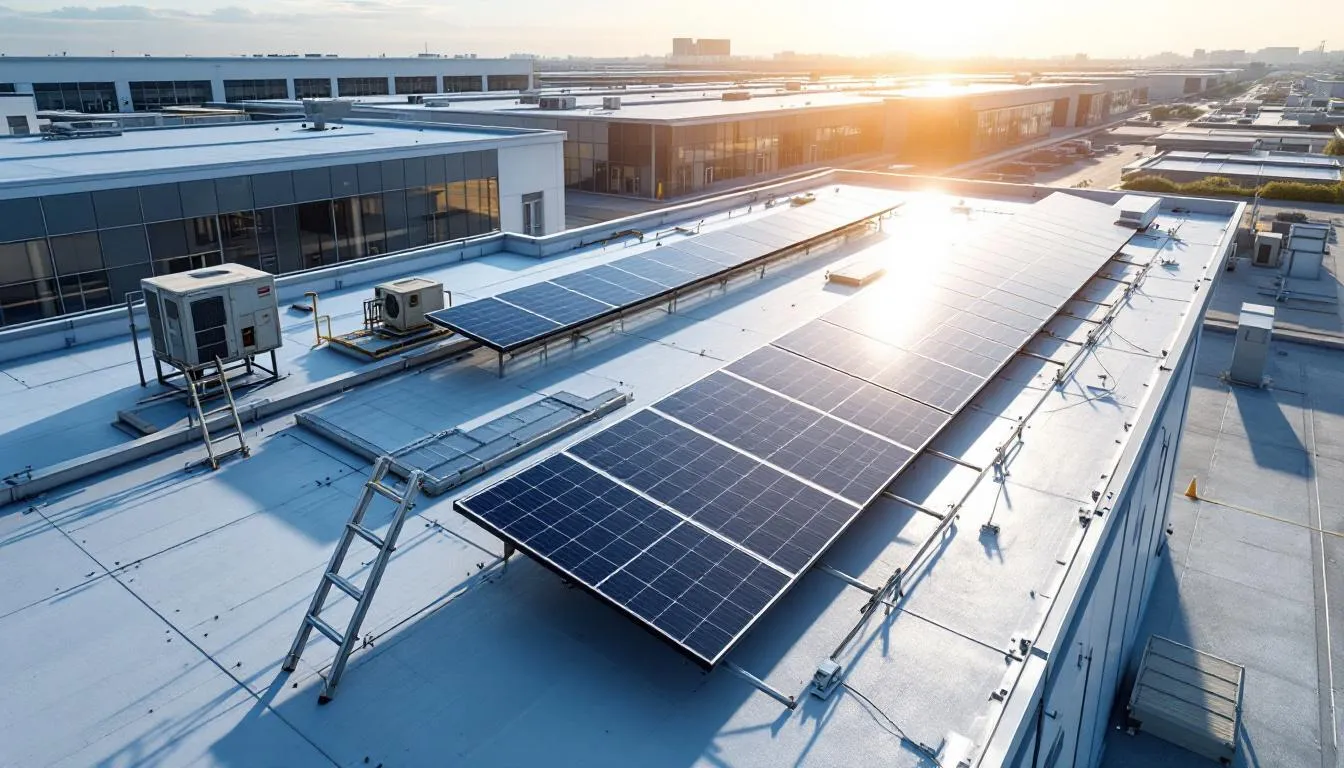
Industrial Flex Space Roofing in Corpus Christi, TX
One low-slope roof, several tenants, and years of undocumented penetrations punched through it. We reroof Corpus Christi flex buildings without losing track of a single one.
One roof serving tenants who keep changing it
An industrial flex building is the most modified roof in the commercial inventory, and the modifications are usually undocumented. The same long, low-slope roof might sit over a machine shop in one bay, a distribution tenant in the next, a contractor's warehouse beside that, and an office or showroom build-out at the front, with those uses shuffling every time a lease turns. Each tenant who moves in adds a rooftop HVAC unit, drops a new electrical or refrigerant line through the deck, or sets equipment that was never in the original loading plan, and almost none of it makes it into the building records. By the time an owner calls about a leak, the roof is carrying a decade of penetrations nobody has a map for. That is the defining challenge of flex roofing, and it is why we start every one of these jobs by finding out what is actually up there.
The penetration inventory comes first
Before we price or spec a flex reroof, we survey the roof and photograph and map every penetration on it, then compare that against the original construction documents where they exist. The point is to find the non-standard work: the curb a tenant's HVAC contractor set without proper flashing, the abandoned penetration somebody covered with mastic and forgot, the conduit run sealed with the wrong material. Those are the spots that leak and the spots that turn into warranty fights after a project if they are not dealt with up front. On a multi-tenant building this survey is not optional housekeeping, it is the foundation of the whole scope, because you cannot warrant a roof you have not accounted for. We remediate the problem penetrations as part of the work rather than burying them under new membrane.
Corpus Christi's flex corridors
Flex and light-industrial product is spread across Corpus Christi's working corridors, and the building stock varies wildly by era. The Corpus Christi Business and Job Development corridors along I-, Leopard Street, and Agnes Street hold older tilt-wall and built-up-roof buildings going back to the 1970s and 80s. Newer pre-engineered metal flex buildings with standing-seam or R-panel roofs have gone up around the airport, along Saratoga and the Southside service corridors, and out toward the Calallen and I-37 north interchanges where land is cheaper. The energy-services, oilfield-supply, marine, and contractor tenants that drive a lot of the Coastal Bend economy fill these bays, and they come and go on their own lease cycles. A reroof spec that fits a 1980s tilt-wall building is not the spec for a modern metal building next door, so we match the approach to the deck and the tenancy.
Membrane choices for tilt-wall and pre-engineered metal
For tilt-wall and concrete flex buildings, the workhorse is a heavier mechanically attached TPO over fresh polyiso, often tapered to fix the drainage that has degraded over the years. On buildings with high rooftop equipment density or heavy foot traffic from multiple tenants' service contractors, we step up to a thicker membrane or a fully adhered system for the extra puncture and traffic resistance, because a multi-tenant roof gets walked on constantly. Pre-engineered metal buildings are a different decision: depending on panel condition, purlin spacing, and load capacity, a standing-seam recover system or a coated-metal restoration can extend the roof's life without a full teardown, which keeps tenants operating and controls cost. We evaluate both paths against the building's real condition rather than defaulting to a tear-off.
Coordinating bays, tenants, and vacancy gaps
Multi-tenant work runs through property management, not around it. We start with a bay-by-bay occupancy map and a tenant contact list, identify which bays have active rooftop equipment and which sit vacant, and flag the tenants sensitive to noise or HVAC downtime. Tenants get advance notice, but communication flows through the property manager so the crew is not fielding a dozen separate conversations on the roof. Vacancy is its own risk on flex space: when a tenant pulls out and their HVAC unit comes off, the curb opening is often left under a temporary cap that fails within a rain event or two, and vacant bays collect drain-clogging debris faster than occupied ones. Our lease-transition inspections confirm curb cap status, check that former-tenant penetrations are properly sealed, and verify the drains are clear. For owners and investors running several properties, we provide standardized condition reports that feed straight into capital planning across a portfolio.
Industrial Flex Space Roofing Questions
How do you deal with all the tenant penetrations on a flex roof?
We survey the roof first and photograph and map every penetration, then compare it to the original drawings where they exist. That finds the improperly flashed curbs, abandoned openings, and badly sealed conduit runs that actually leak, and we remediate them before new membrane goes down rather than burying them. On a multi-tenant building that survey is the foundation of the scope and what makes the warranty hold.
What membrane is best for a multi-tenant flex building?
For tilt-wall and concrete buildings, a heavier mechanically attached TPO over tapered polyiso is the usual cost-effective choice. Where there is high equipment density or heavy service-contractor traffic, we step up to a thicker or fully adhered system for better puncture and traffic resistance.
How do you coordinate around multiple tenants with different schedules?
Through property management. We work from a bay-by-bay occupancy map and tenant contact list, identify active rooftop equipment and vacant bays, and flag noise- or downtime-sensitive tenants. Tenants get advance notice, but communication runs through the property manager so the crew stays focused on the work.
Do you handle standing-seam metal roofs on pre-engineered buildings?
Yes. Depending on panel condition, purlin spacing, and load capacity, a standing-seam recover or a coated-metal restoration can extend the roof's life without a full teardown. We evaluate that against full replacement based on the building's actual condition and spec and install both.
What should I check when a tenant vacates a bay?
Removed HVAC units leave curb openings that are often capped temporarily and fail fast, and vacant bays collect debris that clogs drains. Our lease-transition inspection confirms curb cap status, checks that former-tenant penetrations are properly sealed, and verifies the drains are clear. Portfolio owners also get standardized condition reports for capital planning.
What We Document
Membrane, seams, laps, edges, drains, scuppers, curbs, penetrations, rooftop units, and previous repairs.
Salt-air corrosion, wind exposure, ponding, blocked drainage, wet insulation clues, and interior leak evidence.
The practical split between immediate repair, maintenance, restoration review, recover planning, and replacement budgeting.
Daily dry-in expectations and closeout photos for ownership review.