
Airport Terminal & Aviation Facility Roofing roof access, staging space, and tenant or operations limits.
Airport Terminal & Aviation Facility Roofing in Corpus Christi, TX
An airport never closes, and the roof work has to respect that before anything else. Corpus Christi International Airport (CRP) moves Coastal Bend travelers on American, United, and Southwest connections day and night, and right next door the Naval Air Station runs one of the Navy's largest flight-training operations. Roofing on a live aviation campus is governed by the airfield's clock and its rulebook, not by a standard commercial schedule, and we plan it that way from the bid forward.
Coordination Comes Before the Roof
On an operating airport, every access point, every material lift, and every crew movement has to be cleared through the airport's facilities department and its FAA Part 139 safety program, and on the secure side, through TSA protocols. We build that coordination into the project scope before the contract is signed instead of discovering it after the trucks arrive. Material deliveries, crane picks, and any work near airside areas get scheduled into approved windows, and where the airfield requires it we work through the FAA NOTAM process. This is routine setup for us on aviation work, not an exception we are figuring out on your building.
Aviation Roofs Carry Loads Ordinary Buildings Don't
The roof systems on terminals and aviation support structures take punishment a comparable warehouse never sees. Roofs within reach of taxiing aircraft face jet-blast exposure, which means membrane adhesion and ballast have to be specified well beyond a standard logistics-building detail or the wind from an engine run-up will lift it. Terminal mechanical systems are denser and heavier than typical commercial, so the roof carries a high count of large curbed penetrations, each one a flashing detail that has to be engineered rather than copied. And terminal roofs tend to be huge, nearly flat expanses where drainage design is everything and ponding tolerance is essentially zero — water has to be driven to the drains, not left to sit on a dead-level deck baking in the Gulf sun.
The Whole Campus, Not Just the Terminal
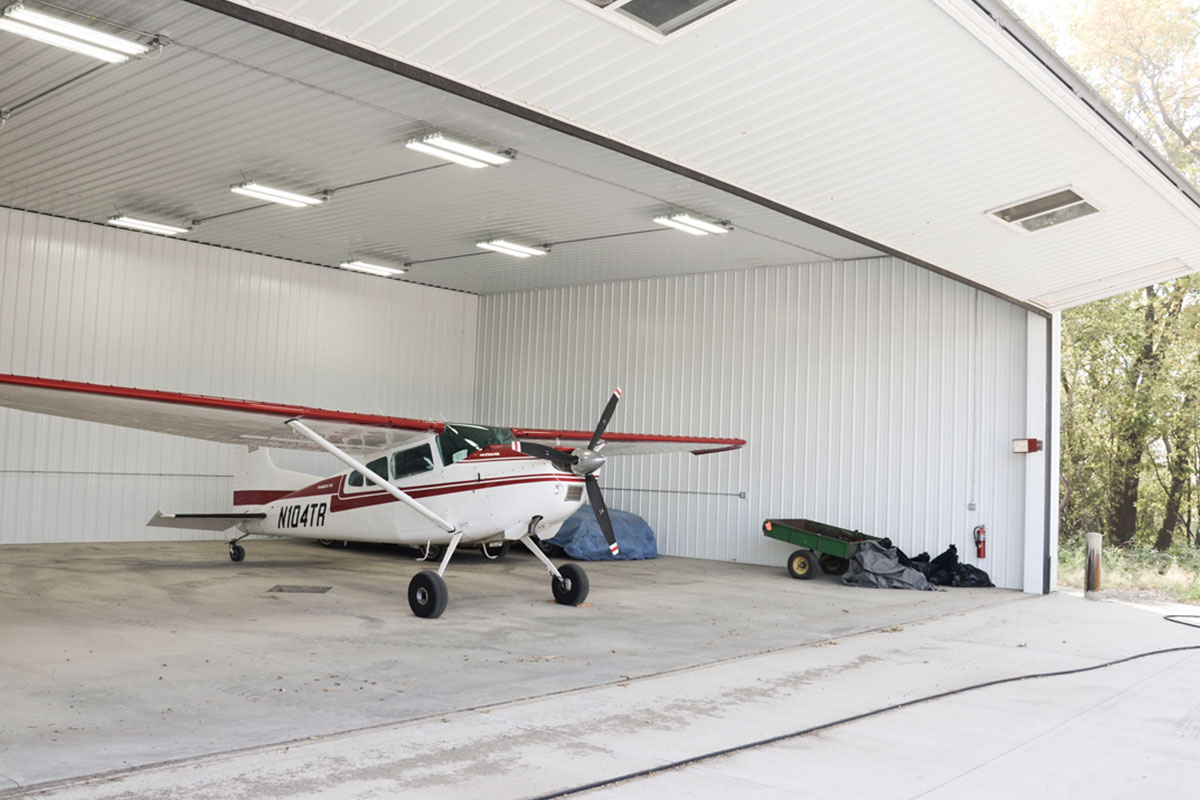
An airport is a collection of very different buildings. Cargo facilities, rental-car centers, FBO operations, aircraft maintenance shops, and on-campus hotels each present their own roofing problem, but the one constant is access control — badging and security clearance apply across the entire property, and our crews treat that as non-negotiable and plan for it rather than running into it onsite. The general-aviation side eases the security intensity but raises the structural difficulty: high-bay hangars are wide clear-span buildings whose roofs generate serious wind uplift, and they need fastening patterns and seam geometry built for those loads. The Naval Air Station complex drives steady demand for that kind of military-grade hangar and maintenance-facility work throughout the Coastal Bend, alongside the commercial terminal side at CRP.
A Public Roof Over a Working Lobby
A terminal roof sits over a space full of travelers, ticketing systems, baggage equipment, and security checkpoints, none of which can shut down for a leak. That changes how the work is staged. Tear-off and dry-in over occupied concourse and ticketing areas are sequenced so the public space below stays open and dry, with each section confirmed watertight before the day ends — a drip onto a checkpoint conveyor or a gate-area floor is an operational incident, not a cosmetic one. Overhead protection, debris control, and noise timing around the passenger flow are part of the plan we hand the airport, not afterthoughts.
Maintenance Keeps the Gates Open
Because a terminal roof is so hard to access and so costly to fail, the smart money on aviation roofs goes into staying ahead of problems rather than reacting to them. The dense field of curbs, the jet-blast-exposed edges, and the near-flat drainage all need eyes on them on a regular cycle, ideally before each hurricane season. We set up scheduled inspections and preventive maintenance for terminals, hangars, and the support buildings around the campus — clearing drains, checking edge securement and seam laps, catching backed-out fasteners and split pitch pockets, and logging it all in a file the facilities team can plan a budget against. Catching a failing detail during a routine walk is a fraction of the cost and disruption of an emergency repair over an open gate.
Coastal Weather on an Exposed Airfield
An airfield is flat and open by design, which leaves these roofs fully exposed to Gulf wind with nothing to break it. Corpus Christi's hurricane season runs June 1 through November 30, and on a roof this size wind uplift is a primary design load. Salt air corrodes edge metal, fasteners, and the heavy rooftop equipment faster than it would inland. We specify securement and attachment for genuine coastal exposure, detail the corrosion-prone metal accordingly, and document storm readiness so the airport has a clean baseline going into each season — because a roof failure on a terminal closes gates and strands travelers.
Airport & Aviation Roofing Questions
We develop a phased plan with the airport facilities department and the FAA Part 139 coordinator and get it approved by airport operations. Deliveries, crane lifts, and any airside-adjacent work go into approved windows, with FAA NOTAM coordination where the airfield requires it. This is standard project setup for us on aviation work.
Most terminal reroofing here uses a single-ply membrane over tapered insulation engineered to drive water to the drains and eliminate ponding on near-flat decks. New high-bay aviation structures and hangars are often specified in standing-seam metal. The choice depends on the existing deck, its load capacity, and operational constraints, and we set the spec after walking the roof with your facilities engineer.
Terminal mechanical density runs well above standard commercial. Our pre-project survey documents every penetration, curb height, and clearance before we build the work plan, and oversized equipment curbs and complex through-penetrations are flashed with individually engineered details rather than generic patterns.
Yes, with the proper badging and in full coordination with airfield operations. Airside work takes a higher level of pre-planning and crew credentialing, which we build into the bid timeline, and we do not put a crew member on the airfield without confirmed airside authorization.
Yes. Hangar roofing — from a single-bay private hangar to a multi-unit FBO complex — is a regular part of our work. High-bay hangars built on wide-flange steel or pre-engineered systems have specific uplift and thermal-movement behavior, and we spec and install roofs that account for it.
Send the building or campus location, roof age if known, access and security requirements, and any prior reports. We will map a coordinated roof walk around airport operations and keep the scope tied to what we can verify on the deck.
What We Document
Membrane, seams, laps, edges, drains, scuppers, curbs, penetrations, rooftop units, and previous repairs.
Salt-air corrosion, wind exposure, ponding, blocked drainage, wet insulation clues, and interior leak evidence.
The practical split between immediate repair, maintenance, restoration review, recover planning, and replacement budgeting.
Daily dry-in expectations and closeout photos for ownership review.